
In differential capacitive accelerometers, the core design is a "sandwich" structure: a movable sensitive mass block in the middle (as a common electrode), and fixed electrodes on the upper and lower sides. When there is no acceleration, the mass block is located in the center, and the upper and lower capacitors are equal: 
When the acceleration α acts along the sensitive axis direction, the inertial force  causes the mass block to produce displacement
  . At this time, the upper and lower capacitors become:

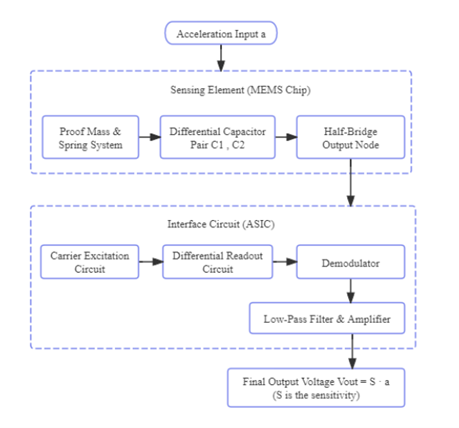 The design scheme usually uses a differential half bridge circuit to extract signals. The relationship between output voltage and capacitance difference is:

Substitute the above capacitance expression:

Therefore, a concise linear relationship is obtained: 
Combined with the mechanical equilibrium equation  (where k is the stiffness of the elastic beam), the final result is:
The brilliance of this design scheme lies in the fact that the output is strictly proportional to the acceleration α, and the denominators  and
and  can be precisely controlled through photolithography accuracy, allowing for precise sensitivity design. Meanwhile, the differential structure eliminates common mode interference (such as temperature drift and power supply fluctuations), making it a very mature solution in engineering.
ترك رسالة
امسح ضوئيًا إلى WeChat :