
Automated and high-precision operations for outdoor base stations (e.g., satellite communication antennas), construction machinery (e.g., excavators, AGVs), and downhole oil and gas equipment (e.g., logging tools) rely heavily on stable, reliable attitude sensing and navigation/positioning capabilities. However, these applications often face extreme environmental challenges, including wide operating temperature ranges (-40°C to +85°C), intense vibration, high shock loads, high humidity, and electromagnetic interference.
Conventional inertial navigation products are prone to issues such as bias drift and nonlinear scale factor variations in these environments, leading to reduced measurement accuracy. Consequently, inertial navigation products must be rigorously adapted across three dimensions—hardware selection, temperature compensation, and algorithmic interference rejection—to meet the stringent requirements of industrial-grade applications.
Hardware serves as the first line of defense against environmental interference. For harsh operating conditions, hardware selection for inertial navigation products must prioritize the following characteristics:
Products must support an operating temperature range of -40°C to +85°C. Simply using wide-temperature components is insufficient to guarantee accuracy; system-level calibration across the entire temperature range is essential. By establishing full-temperature parameter models (e.g., temperature coefficients for bias and scale factor) for MEMS gyroscopes and accelerometers and applying compensation, error divergence in environments with significant temperature fluctuations can be significantly mitigated. For instance, certain high-specification IMUs can maintain bias stability within 0.1°/s across the entire temperature range.
Construction machinery and downhole equipment are often subjected to shocks of up to 20,000g and vibrations of 10grms. Inertial navigation housings must utilize high-strength materials—such as magnesium-aluminum alloys—and feature sealing designs rated IP67 or higher to prevent the ingress of dust and liquids. Additionally, internal structural optimization is required to minimize the impact of assembly stress on sensor performance.
Hardware determines the baseline performance, while algorithms determine the performance ceiling. For wide-temperature operating environments, algorithmic adaptation strategies include:
Relying solely on hardware-based temperature compensation (such as thermistor-based methods) is often insufficient to meet high-precision requirements. Current mainstream approaches employ data-driven modeling techniques—such as using Fourier series expansions to characterize the impact of temperature fluctuations on heading, or utilizing Particle Swarm Optimization (PSO) to identify temperature-error models—to achieve precise compensation for zero-bias drift. Literature indicates that such integrated compensation techniques can reduce temperature-induced heading errors by 40% to 90%.
Environments with intense vibration introduce high-frequency noise, leading to angular rate random walk and the accumulation of velocity errors. By implementing adaptive filtering and resonance suppression techniques (e.g., notch filters), it is possible to effectively distinguish between actual motion and interfering vibrations, thereby mitigating the impact of noise on integrated attitude solutions. Furthermore, by combining these methods with Kalman filtering and utilizing accelerometer and magnetometer data for the online correction of gyroscope drift, attitude accuracy can be maintained during brief periods of GNSS denial or signal loss.
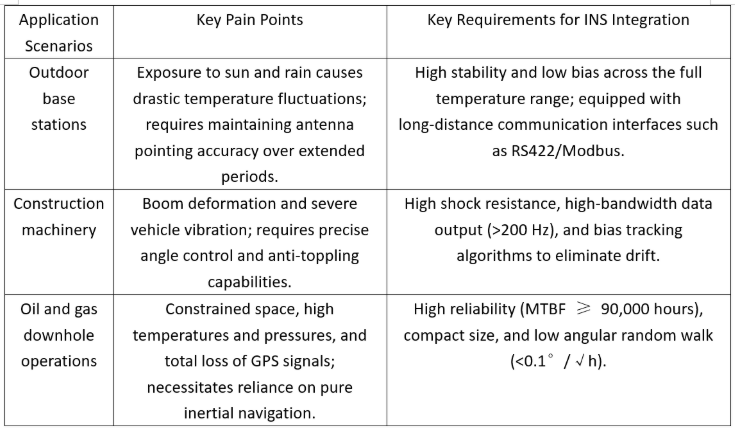
In summary, inertial navigation products designed for wide-temperature environments—such as outdoor base stations, construction machinery, and oil wells—are far more than a mere assembly of components. Their technical core lies in hardware ruggedness, temperature-resilient algorithms, and system-level interference immunity. The key to achieving highly reliable, long-lasting industrial inertial navigation lies in utilizing automotive- or industrial-grade wide-temperature MEMS chips, performing precise calibration and compensation across the full temperature range prior to shipment, and incorporating advanced filtering algorithms optimized for vibration and thermal drift.
ترك رسالة
امسح ضوئيًا إلى WeChat :